Australian Property Investment Tax Decision Guide: Navigating the 2026 Reforms
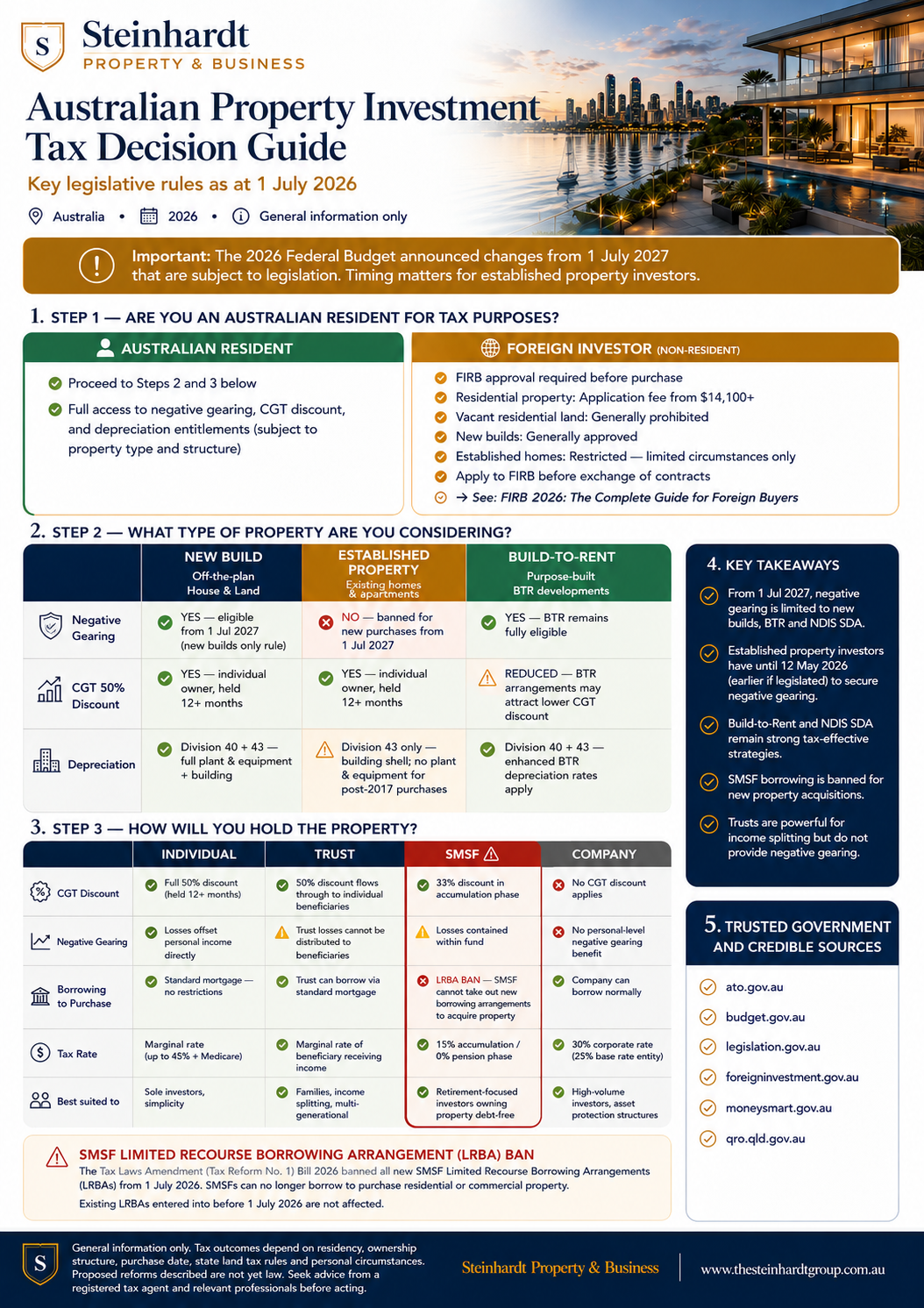
The Tax Laws Amendment (Tax Reform No. 1) Bill 2026 is now law. From 1 July 2027, negative gearing on residential property is restricted to new builds. From 1 July 2026, SMSFs can no longer establish new limited recourse borrowing arrangements. This article sets out the three-step framework — residency, property type, and ownership structure — that determines which rules apply.
The Tax Laws Amendment (Tax Reform No. 1) Bill 2026 has passed both chambers of the Australian Parliament and received Royal Assent. For property investors, the legislation is not a proposal or a consultation — it is law. The question now is not whether the rules change, but how to navigate them.
The LRBA changes commence 45 days after Royal Assent (commencing 10 Aug 2026) and restrict new LRBAs so that, for real property, the asset must be business real property; confirm specific commencement and scope with your SMSF adviser.
This article sets out the framework. A one-page print-ready decision guide — covering residency, property type, and ownership structure in a single reference — is available to Sovereign Investor members at the bottom of this page.
What the legislation actually says
The Act introduces two primary changes relevant to residential property investors.
Negative gearing restriction, effective 1 July 2027: From that date, deductions for losses on residential rental properties will only be available for new residential buildings. Investors who purchase established properties — existing houses, established apartments, and secondary-market dwellings — contracted after the Budget announcement will no longer be able to offset rental losses against other taxable income. Losses on established properties will instead be quarantined and carried forward to offset future income from the same property.
SMSF limited recourse borrowing ban, effective 1 July 2026: The Act prohibits self-managed superannuation funds from entering into new limited recourse borrowing arrangements to acquire property or other assets. LRBAs entered into before 10 August 2026 are not affected.
The legislation is available in full on legislation.gov.au. Investors should confirm how these provisions interact with their specific circumstances with a registered tax agent.
The negative gearing split: new builds versus established property
The most commercially significant change is the restriction of negative gearing to new residential buildings. From 1 July 2027, investors holding established residential property acquired after the Budget cutoff will lose the ability to claim rental losses against other income immediately — the tax benefit that made negatively geared established property a mainstream investment strategy is removed for new purchasers from that date.
New residential buildings — properties sold off-the-plan, house and land packages, and purpose-built dwellings contracted with a developer — retain full negative gearing eligibility. According to ATO guidance on rental property deductions (ato.gov.au), the depreciation and deductibility category of a property turns on its construction date and whether it has been previously used as residential accommodation. Investors should confirm that the specific property they are evaluating meets the ATO's definition of a new residential building before relying on negative gearing eligibility.
The legislation includes a grandfathering provision. Investors who had exchanged contracts on established properties before the Budget announcement on 12 May 2026 are generally understood to retain negative gearing under the old rules. The specific interaction of the grandfathering clause with various contract structures — including long settlements, option agreements, and off-market contracts — warrants professional confirmation.
The practical implication for investors evaluating established property is direct: the after-tax cash flow model that applied under the old regime no longer applies to new acquisitions from 1 July 2027. Modelling should reflect the quarantined-loss treatment.
Build-to-Rent developments — purpose-built apartment complexes designed for long-term residential tenancy — remain fully eligible for negative gearing and attract enhanced depreciation treatment under the 2026 legislation. NDIS Specialist Disability Accommodation, as a new-build class, similarly retains full eligibility.
Depreciation: the ongoing distinction between new and established
Independent of the 2026 reforms, the depreciation treatment of established residential property has been restricted since the Treasury Laws Amendment (Housing Tax Integrity) Act 2017. Investors who purchase established residential properties are entitled to claim Division 43 deductions (the building allowance on the construction cost) but are not entitled to claim Division 40 deductions for plant and equipment — fixtures, fittings, carpet, appliances — unless they acquired those items themselves in a new condition.
This restriction predates the 2026 reforms and remains in place. Investors in new builds continue to access both Divisions 40 and 43, making the full depreciation schedule available. The ATO's rental properties guide (ato.gov.au/rental) covers both divisions in detail and is the primary reference for depreciation entitlements.
The SMSF borrowing ban: immediate and unconditional
The SMSF provision takes effect sooner and is less conditional. From 10 August 2026, an SMSF that has not already entered into an LRBA cannot borrow to acquire property — residential or commercial — through that structure. The leveraged property acquisition strategy that was a feature of SMSF investment planning for the past decade is closed for new arrangements.
An SMSF can still acquire property outright using accumulated fund assets, and can hold existing LRBA properties under pre-existing arrangements. But the capacity to gear inside superannuation — to borrow in order to amplify exposure — no longer exists for new transactions.
The tax environment inside an SMSF otherwise remains unchanged. Rental income and capital gains in the accumulation phase are taxed at 15 per cent; in the pension phase, that rate falls to zero per cent. The CGT discount available to SMSFs in the accumulation phase is one-third — reducing the effective rate to 10 per cent on assets held more than 12 months — rather than the 50 per cent available to individual investors.
Ownership structure: the decision that precedes the property
The choice of ownership structure determines which legislative rules apply and in what combination. The four principal structures — individual, discretionary or unit trust, SMSF, and company — each present a materially different tax profile after the 2026 reforms.
Individual ownership remains the simplest and, for most investors acquiring new builds under the post-2027 negative gearing rules, the most direct. Losses offset personal income at the investor's marginal rate. The 50 per cent CGT discount applies to assets held for more than 12 months. No structural complexity or trustee obligations.
Discretionary or unit trusts retain the ability to hold negatively geared new-build property — a trust is not excluded from the negative gearing rules that apply to individuals. The key restriction is that trust losses cannot be distributed to beneficiaries; they are quarantined within the trust and offset against future trust income. Trusts remain effective for income splitting in years when a property is positively geared, and the 50 per cent CGT discount flows through to individual beneficiaries on disposal. The interaction of trust distribution provisions with family trust elections is an area where specialist advice is strongly recommended.
SMSFs, as noted, can no longer borrow to acquire property. For investors whose strategy depended on leveraged property inside super, the structure's attractiveness for future property acquisition diminishes unless the fund holds sufficient liquid assets to acquire outright. The tax rates — 15 per cent in accumulation, nil in pension phase — remain compelling for appropriately capitalised funds.
Company structures receive no CGT discount on disposal, pay tax at the corporate rate of 30 per cent (25 per cent for base rate entities), and cannot distribute negative gearing losses to shareholders in a way that reduces their personal income. They are generally unsuitable as the primary holding structure for investment property but may serve a role in multi-property portfolios where asset protection and income retention are priorities.
Foreign investors: the FIRB framework is unchanged
The 2026 tax reforms do not alter the Foreign Investment Review Board approval framework. Non-resident investors remain subject to FIRB approval requirements before acquiring residential property in Australia. According to foreigninvestment.gov.au, application fees for residential real estate begin at $14,100 and scale with purchase price. FIRB retains strict controls over foreign acquisition of established dwellings and sets development/condition requirements for vacant residential land; foreign acquisition of vacant land is permitted in specified circumstances and subject to FIRB approval and conditions. New builds remain the principal approved category for foreign residential investors.
The negative gearing restriction applies equally to non-residents holding Australian residential property through Australian tax structures. Residency for tax purposes — a separate determination from visa or citizenship status — governs which rate schedule applies to Australian-sourced income. Non-residents who are uncertain of their Australian tax residency status should seek advice from a registered tax agent before purchasing.
What investors should do now
The policy direction of the reforms is clear and the legislation is enacted. The practical steps that follow depend on the investor's current position.
Investors holding established property contracted after 12 May 2026 should model their cash flow under the new regime — assuming negative gearing is unavailable from 1 July 2027 — and confirm with their tax agent whether any grandfathering provision applies to their specific contract structure.
Investors with SMSF strategies that included future leveraged property acquisition should reassess those plans in consultation with their SMSF auditor and financial adviser. Existing LRBAs entered into before the commencement of Schedule 5 (10 Aug 2026) are preserved; from commencement, LRBAs for real property are limited to assets that are business real property — meaning LRBAs for residential property will generally be excluded while borrowings for qualifying business real property may still be possible.
Investors evaluating new builds retain access to the full suite of incentives — negative gearing, Division 40 and 43 depreciation, and the 50 per cent CGT discount — but should confirm that the specific property qualifies as a new residential building under the ATO's definition before relying on those entitlements.
Investors considering a trust or company structure should obtain advice on the post-2026 interaction of that structure with the negative gearing and CGT rules before acquisition. The structural choice is difficult to unwind after settlement.
The decision guide
Steinhardt Property & Business has produced a single A4 reference guide covering the three-step decision framework — residency, property type, and ownership structure — in a format designed for use with advisers and in investment committee discussions. The guide consolidates the legislative rules, colour-codes the key outcomes, and references primary government sources throughout.
The guide is available as a PDF download exclusively to Sovereign Investor members. Access is free — register at The Sovereign Investor if you have not yet done so.